

Are you dreaming of a new life in the Great White North but worried you don’t have a PhD or a decade of corporate experience? What if I told you that Canada is looking for people just like you to fill thousands of essential roles right now? In 2026, the gateway to the Canadian dream isn’t just for doctors and engineers. It is wide open for those looking for TEER 4 jobs in Canada.
But what exactly are these jobs? Why is the government making it easier for foreigners to move here for these roles? And most importantly, how can you find a job that offers a visa and a path to permanent residency?

In this complete guide, you will learn:
- What TEER 4 jobs mean
- Which TEER 4 occupations are in demand
- Average salaries
- Best provinces for jobs
- LMIA and visa sponsorship options
- PR pathways
- How to apply from outside Canada
If you are planning to work in Canada in 2026, this guide will help you understand everything step by step.
Introduction: The Rise of TEER 4 Jobs in Canada
Let’s start with a simple question: Have you noticed that your local grocery store or favorite online retailer is always hiring? In Canada, this isn’t just a trend; it is a full-blown labor crisis. The country is getting older, and there aren’t enough local workers to keep the economy moving. This is where TEER 4 jobs in Canada come into play.
TEER 4 occupations are those that usually require a high school diploma or several weeks of on-the-job training. These aren’t just “entry-level” roles; they are the backbone of Canadian society. From the people who pack your food to those who drive delivery trucks, these workers are essential.
Currently, Canada jobs for foreigners are more accessible in this category because the labor shortage is most intense in service and labor-heavy industries. Employers are desperate. Because of this, many companies are now offering visa sponsorship TEER 4 jobs to attract talent from across the globe. If you are looking for a way to move your family to a safe, prosperous country, targeting these specific roles is one of the smartest moves you can make in 2026.
What Does TEER 4 Mean?
You might be confused by all the jargon. What is a NOC? What happened to the old “Skill Levels”? Don’t worry; it’s simpler than it looks.
The TEER system Canada uses stands for Training, Education, Experience, and Responsibilities. It replaced the old Skill Level A, B, C, and D system to be more accurate. Canada uses the National Occupational Classification (NOC) to categorize every single job in the country.
TEER 4 jobs in Canada fall right in the middle of the spectrum. These jobs typically require a high school diploma, or perhaps a short period of specific training (like a forklift license or a food safety certificate). They are a step above TEER 5 (which usually requires no formal education) but don’t require the university degrees seen in TEER 0, 1, or 2.
Understanding the TEER 4 occupations is vital because your eligibility for certain immigration programs depends on your job’s TEER level.
The TEER Hierarchy at a Glance
| TEER Level | Education & Training Required | Common Examples |
| TEER 0 | Management roles | Bank Managers, Construction Managers |
| TEER 1 | University degree (Bachelor’s, Master’s) | Software Engineers, Accountants |
| TEER 2 | College diploma or 2+ years of apprenticeship | Registered Nurses, Electricians |
| TEER 3 | College diploma or <2 years of apprenticeship | Bakers, Dental Assistants |
| TEER 4 | High school diploma or weeks of training | Home Care Workers, Truck Drivers |
| TEER 5 | Short work demonstration (no formal education) | Fruit Pickers, Cleaning Staff |
As you can see, TEER 4 jobs in Canada provide a perfect balance for those looking for jobs in Canada without degree requirements. You have a formal classification that the government recognizes, which makes your work permit application much stronger.
TEER 4 jobs usually require:
- High school education
- On-the-job training
- Basic communication skills
- Some work experience in certain cases
These jobs are often practical and physically active. Many industries in Canada depend heavily on TEER 4 workers.
List of Top TEER 4 Positions in Canada in 2026
So, what does the TEER 4 occupations list Canada actually look like? There are hundreds of roles, but some are in much higher demand than others. When you look for foreign worker jobs Canada, you want to target the ones where employers are actually willing to pay for an LMIA.
Here is a breakdown of the best TEER 4 jobs in Canada for 2026:
1. Warehouse Worker
The rise of e-commerce has made warehouse TEER 4 jobs some of the most common roles available. You will be responsible for sorting, packing, and shipping goods. The work is physical, but it is steady. Most of these are food packing jobs Canada specifically, as the supply chain for groceries is always hiring.
- Salary: $18 – $24 per hour.
- LMIA Availability: High.
2. Truck Driver (Short-haul / Delivery)
While long-haul trucking is often a different TEER level, many local delivery and truck driver TEER 4 jobs are available for those with the right license. You don’t always need a massive tractor-trailer license; sometimes a commercial class license for a cube van is enough.
- Salary: $22 – $30 per hour.
- LMIA Availability: Very High.
3. Caregiver & Home Support Worker
This is arguably the most important role on the list. Caregiver TEER 4 jobs involve helping the elderly or people with disabilities in their private homes or care facilities. Because of the aging population, this is a top-tier PR pathway job Canada.
- Salary: $19 – $26 per hour.
- LMIA Availability: Massive (often through special pilots).
4. Construction Helper
Are you good with your hands? Construction helper jobs Canada are booming as the country tries to build millions of new homes by 2030. You will assist tradespeople, move materials, and keep sites safe.
- Salary: $20 – $27 per hour.
- LMIA Availability: Moderate to High.
5. Hotel Front Desk / Receptionist
If you have great English skills and a friendly personality, hotel jobs TEER 4 are a great way to enter the Canadian workforce. Tourism is back in full swing in 2026, and hotels in Banff, Toronto, and Vancouver need staff.
- Salary: $17 – $23 per hour.
- LMIA Availability: Moderate.
6. Factory Worker & Machine Operator
In provinces like Ontario and Quebec, factory jobs Canada are plentiful. You might work on an assembly line or operate simple machinery. These are often jobs in Canada without IELTS requirements if the workplace is primarily non-client facing (though basic English is always a plus).
- Salary: $19 – $25 per hour.
- LMIA Availability: High.
Highest Paying TEER 4 Jobs in Canada
Who says you can’t earn a great living in an intermediate-skilled role? While these are TEER 4 jobs in Canada, the pay can vary wildly depending on the province and the specific industry.
The TEER 4 salary is generally high-paying jobs in Canada in the western provinces like Alberta and Saskatchewan compared to the Atlantic provinces, simply because the cost of living and labor demand are higher there. However, even in “lower-paying” provinces, your money might go further because rent is cheaper.
Salary Comparison Table (2026 Estimates)
| Job Title | Average Hourly Wage | Top Province for Pay | Demand Level |
| Construction Helper | $25.50 | Alberta | Extreme |
| Home Support Worker | $23.00 | British Columbia | Very High |
| Warehouse Lead Hand | $24.00 | Ontario | High |
| Truck Driver (Local) | $28.00 | Saskatchewan | High |
| Farm Supervisor (Teer 4) | $22.50 | Manitoba | High |
| Food Production Worker | $24.00 | Ontario | High |
| Hotel Supervisor | $25.00 | Ontario | High |
When looking for the highest paying TEER 4 jobs, always look at the “hidden” benefits. Some farm worker jobs Canada offers include free or subsidized housing. This can save you $1,500 a month in rent, which effectively makes your salary much higher than someone working in a city!
TEER 4 Jobs in Canada for Foreign Workers
If you are applying from outside the country, you need to understand how the “legal” part works. You can’t just hop on a plane and start working. For most TEER 4 jobs in Canada, you will need a work permit.
Most employers hiring from abroad use the Temporary Foreign Worker Program (TFWP). To hire you, the employer usually needs an LMIA (Labour Market Impact Assessment). This document proves to the government that no Canadian was available to do the job.
Why target LMIA TEER 4 jobs?
Because an LMIA-supported job offer is like a golden ticket. It allows you to apply for a closed work permit. Many people search for visa sponsorship TEER 4 jobs because it means the employer is willing to handle the paperwork and fees associated with the LMIA.
Don’t be discouraged if a job says “Canadian Residents Only.” Keep looking for those specifically tagged as Canada jobs for foreigners. There are thousands of employers in 2026 who have “blanket LMIAs,” meaning they are pre-approved to hire dozens of people from overseas at once.
Best Provinces for TEER 4 Occupations
Where should you pack your bags for? Canada is huge, and every province has its own personality—and its own labor needs. If you want the best chance of finding TEER 4 jobs in Canada, you need to go where the people aren’t!
Alberta: The Land of Opportunity
Alberta is currently the “it” province. With no provincial sales tax and a booming energy and construction sector, TEER 4 jobs in Canada located in Calgary or Edmonton pay very well. The Alberta Opportunity Stream is also a fantastic pathway for foreigners already working in the province.
Saskatchewan: The Hidden Gem
If you want a PR pathway job Canada, look at Saskatchewan. Their Provincial Nominee Program (Saskatchewan PNP) is very friendly to TEER 4 workers, especially in health, agriculture, and trucking. It is much easier to get PR here than in Toronto.
Ontario: The Big Stage
Ontario has the most jobs, but also the most competition. You will find endless warehouse TEER 4 jobs in the “Golden Horseshoe” area (near Toronto). However, be prepared for high rent.
British Columbia: Beautiful but Expensive
B.C. has a massive need for caregiver TEER 4 jobs and hospitality workers. If you love the ocean and mountains, this is the place, but ensure your TEER 4 salary in Canada is enough to cover the costs in Vancouver or Victoria.
TEER 4 Jobs That Can Lead to PR
Can you stay in Canada forever with a TEER 4 job? Yes, you absolutely can! In fact, this is why so many people search for immigration TEER 4 jobs.
While the “Express Entry” system often favors people with high education (TEER 0, 1, 2, 3), the PR pathway jobs Canada offers at the TEER 4 level are usually found in the Provincial Nominee Programs (PNP) and specific pilots.
Key PR Pathways for TEER 4 Workers:
- Atlantic Immigration Program (AIP): This is a huge one. It covers New Brunswick, Nova Scotia, PEI, and Newfoundland. It allows employers to hire foreign workers for TEER 4 roles and fast-track them to PR.
- Rural Community Immigration Pilot (RCIP): If you are willing to live in a rural and more remote communities (14 communities available), this pilot is designed specifically for you.
- Caregiver Pilots: If you work in home care, Canada has historically offered direct paths to PR after you gain a certain amount of work experience.
- Provincial “In-Demand” Streams: Provinces like Nova Scotia and Saskatchewan have specific lists of TEER 4 and 5 jobs that qualify for PR after only 6 months of work.
Searching for TEER 4 jobs for immigrants is about more than just the first paycheck; it’s about the Canadian passport at the end of the journey.
How to Find TEER 4 Jobs in Canada
Ready to start your search? Don’t just Google “jobs.” You need to be strategic. Finding TEER 4 jobs in Canada requires using the right tools.
- Canada Job Bank: This is the official government site. Look for the “Green Tick” on job postings—this often indicates the employer is looking to hire foreign workers or has an LMIA.
- Indeed Canada: The biggest private job board. Use keywords like “LMIA” or “Sponsorship” in the search bar.
- LinkedIn: Great for networking. Follow Canadian recruiters who specialize in your industry (e.g., “Saskatchewan Trucking Recruiters”).
- Recruitment Agencies: Some agencies specialize in bringing foreign worker jobs Canada to international talent. Just be careful—never pay an agency to “buy” a job. That is illegal.
A pro tip for finding how to get TEER 4 jobs in Canada: Tailor your resume. Canadian resumes don’t include your photo, your age, or your religion. Keep it professional, focused on your skills, and use a “Chronological” format.
How to Apply for TEER 4 Jobs From Outside Canada
Applying from abroad is a marathon, not a sprint. To successfully secure TEER 4 jobs in Canada, you need to follow a specific process. If you skip a step, your application will likely end up in the trash.
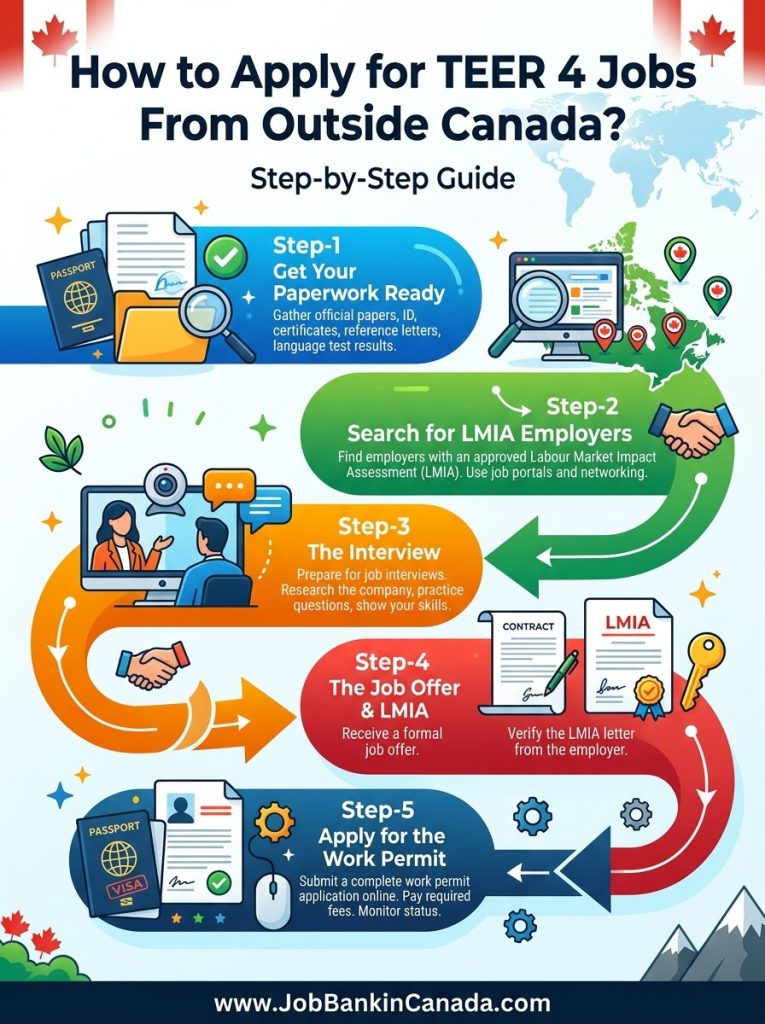
Step-by-Step Guide:
- Get Your Paperwork Ready: Have your high school diploma and any work certificates translated into English or French. If you can, take an English test. Even though some are Canada jobs without IELTS, having a score of 5.0 or 6.0 makes you much more attractive to employers.
- Search for LMIA Employers: Focus your energy on employers who already have experience hiring foreigners.
- The Interview: Most Canadian employers will interview you via Zoom or Teams. Be punctual! Canadian culture values time highly.
- The Job Offer & LMIA: Once the employer likes you, they will send a “Job Offer Letter” and then apply for the LMIA.
- Apply for the Work Permit: Once you have the LMIA number, you apply for your Canada work permit jobs through the IRCC website.
Remember, apply for TEER 4 jobs Canada with honesty. If you lie about your experience, it will be found out during the background check, and you could be banned from Canada for 5 years.
Required Skills & Qualifications
What do you actually need to “make it” in these roles? While these are jobs in Canada without degree requirements, that doesn’t mean they are easy.
To succeed in TEER 4 jobs in Canada, you need:
- Language Skills: You need to understand safety instructions and talk to your boss. Even basic English is essential.
- Physical Stamina: Many factory jobs Canada and warehouse TEER 4 jobs require standing for 8-10 hours or lifting 20kg boxes.
- Reliability: In Canada, showing up 5 minutes late is considered “late.” Being reliable is the #1 way to get promoted.
- Soft Skills: For hotel jobs TEER 4 or retail roles, a “can-do” attitude and a smile go a long way.
Don’t forget specific certifications! Getting a “Standard First Aid” or a “WHMIS” (Workplace Hazardous Materials Information System) certificate online before you arrive can put you at the top of the resume pile.
Common Mistakes Foreign Workers Make
I have seen so many talented people fail because of simple errors. When looking for TEER 4 jobs in Canada, avoid these traps:
- Paying for a Job: In Canada, it is the employer who pays the recruiter. If someone asks you for $5,000 to “guarantee” you a job, it is almost certainly a scam.
- Generic Resumes: If you apply for a construction helper job and a food packing job with the same resume, you won’t get either. Highlight the specific skills for each.
- Wrong NOC Codes: Make sure you are applying for the correct TEER level. If you apply for a TEER 4 job but your experience is actually TEER 1, the employer might think you are “overqualified” and won’t stay.
- Incomplete Applications: If the IRCC asks for a police certificate or a medical exam, provide it immediately. Delays can lead to rejections.
Final Conclusion: Your Path to Canada Starts Now
The year 2026 is a unique time for Canadian immigration. The door for TEER 4 jobs in Canada is wider than ever because the country simply cannot function without essential workers. Whether you are looking for warehouse TEER 4 jobs, caregiver TEER 4 jobs, or construction helper jobs Canada, the opportunity is real.
Remember, moving to Canada is a journey. It starts with a great resume, a lot of research, and the courage to apply. Don’t be afraid of the “TEER 4” label—it isn’t a “low-skill” label; it is an “essential” label.
So, what are you waiting for? Start browsing the TEER 4 occupations list Canada today, find an employer offering visa sponsorship, and take the first step toward your new life. Canada is waiting for you!
Ready to find your role? Check out the official Canada Job Bank today and filter for TEER 4 positions!
FAQs: Everything You Need to Know (Quickly!)
What jobs fall under TEER 4?
TEER 4 jobs in Canada include roles like delivery drivers, home support workers, warehouse staff, construction helpers, and retail sales supervisors. These usually require high school or short-term training.
Is TEER 4 eligible for PR in Canada?
Yes! While not usually eligible for the “Federal Skilled Worker” program, they are highly eligible for the Atlantic Immigration Program (AIP), the Rural and Northern Immigration Pilot (RNIP), and many Provincial Nominee Programs (PNP).
Do TEER 4 jobs require IELTS?
Technically, some work permits don’t “require” it, but for a PR pathway job Canada, you will eventually need to prove your language skills. Most employers also prefer candidates who have taken the test to ensure they can work safely.
Are TEER 4 jobs eligible for Express Entry?
Generally, no. Express Entry is for TEER 0, 1, 2, and 3. However, if you get a Provincial Nomination through a TEER 4 job, you get 600 points, which guarantees you an invitation for PR through the Express Entry system!
Which TEER 4 job pays the highest?
Currently, construction helper jobs Canada and local specialized truck driver TEER 4 jobs in Alberta or the Territories offer the highest hourly wages, often exceeding $28-$30/hour with overtime.
Can foreigners apply directly?
Yes, you can apply directly to employers on Job Bank or Indeed. Just ensure you are looking for those who mention “International Applicants” or “LMIA.”
How long is a TEER 4 work permit?
Usually, these work permits are issued for 1 to 2 years, depending on the LMIA and the employer’s needs. You can often renew them or apply for PR while working.


My name is yirgalem agodo from Ethiopia i am very interested
I am forklift oprator
My names is Mohammed I am from Cairo iam very interested
Ramez Amjad Mohammad Quraish
Zarqa, Jordan
📞 0787228047
📧 bindband34@gmail.com
⸻
🎯 Objective:
A highly motivated hospitality worker with over 4 years of experience in hotels and restaurants is seeking employment in Canada through the Rural Communities Immigration Pilot Program (RCIP). He possesses excellent housekeeping, food service, and customer support skills, along with a strong work ethic and the ability to work effectively as part of a team.
⸻
💼 Experience:
Rotana Hotel – Housekeeping/Food Service
Duration: 1.5 years
Astra Hotel – Housekeeping/Room Service
Duration: 9 months
Royal Hotel – Food Service Assistant
Duration: 2 years
Al Walaa Company – General Worker
Duration: 6 months
Abu Jbara Restaurant – Food Service Worker
Duration: 7 months
⸻
🛠 Skills:
* Housekeeping and Cleaning
* Food Service and Customer Support
* Teamwork
* Quick Learner
* Ability to Work Under Pressure
⸻
🌍 Languages:
* Arabic (Native)
* English (Basic or Intermediate)
⸻
🎯 RCIP Strengths:
* Hospitality Experience (Highly Required)
* Restaurant and Hotel Background
* Experience in Multiple Roles
Good day sir/mam.
im interested for Any Driving job,,
My Driving Job Experience 5 Year,,
I need for Driving Job,, I Have Valid Driving Licences,
I am a child of a very poor mother,
I work hard but I will need a visa Sponsorship
possible position for Covar Van, Pickup,or Motorbike .
i have a valid passport or on the other hand I would like to know if there is no age limits.im 26 y/o but still I want to work please.
My WhatsApp Number +8801341228557
My Gmail
devilhridoy111@gmail.com