

Are you looking for a fresh start in your career? The Better Jobs Ontario program (previously known as Ontario Second Career) is one of the most powerful tools for residents looking to pivot into in-demand industries in Canada.
In 2026, the Ontario government has expanded this program to help more people than ever. Whether you were laid off, are currently in a low-income household, or are working a “survival job,” this guide explains exactly how to unlock up to $35,000 in funding for your future.
What is the Better Jobs Ontario Program?
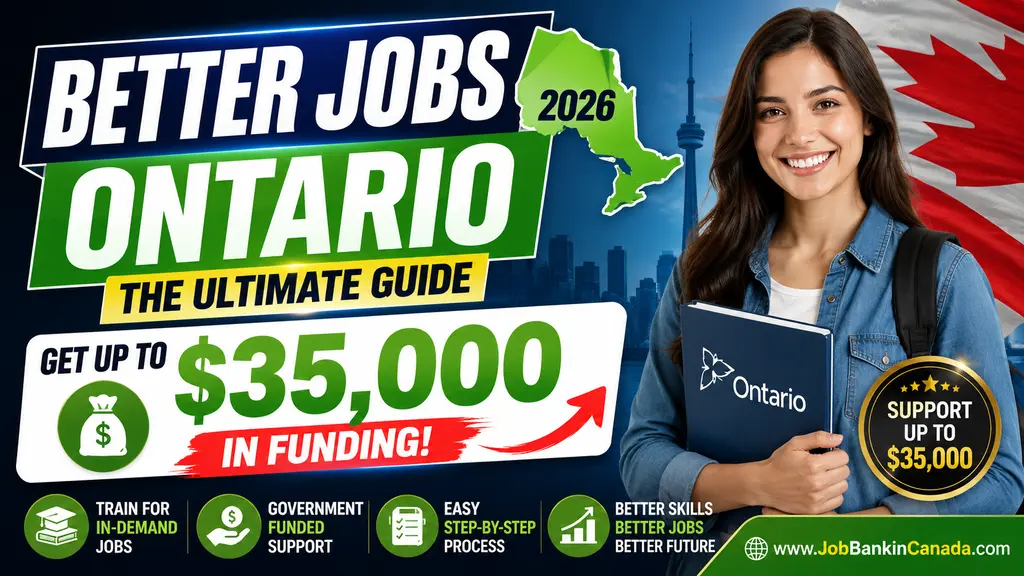
Better Jobs Ontario is a provincial grant in Canada designed to help people get the skills they need for stable, high-paying jobs in Canada. Unlike a loan, this is a grant—meaning you don’t have to pay it back if you follow the program rules.
In early 2026, the program received significant updates. The ministry renamed the old Literacy and Basic Skills (LBS) portion to Get SET (Skills, Education and Training), making the transition from learning to earning much smoother.
Benefits of Better Jobs Ontario Program 2026
The Better Jobs Ontario program is designed to be more than just a tuition grant; it’s a comprehensive support system for career transformation.
Here are the 8 major benefits that make this program a game-changer for Ontario residents in 2026:
- Substantial Tuition Coverage: You can receive up to $28,000 for programs lasting one year or less, and up to $35,000 for longer vocational programs (up to two years).
- Weekly Living Allowance: To help you focus on your studies without financial stress, the program provides a basic living allowance of up to $500 per week to cover essentials like rent and groceries.
- Support for Books and Tech: The grant covers 100% of required instructional costs, including textbooks, lab supplies, and even electronic devices (like laptops) needed for your coursework.
- Additional Funding for Dependents: Parents and caregivers can access extra funding above the standard caps to cover childcare expenses, ensuring your family is taken care of while you retrain.
- Commuting and Travel Assistance: Whether you take public transit or drive, the program provides a transportation allowance to help you get to and from your campus or practicum location.
- Disability-Related Supports: For students with disabilities, the program offers specialized funding for equipment, software, or other accommodations required to succeed in a classroom environment.
- Academic Upgrading Access: If you need to refresh your math or literacy skills before starting your main program, the Get SET (Skills, Education and Training) component pays for your upgrading.
- Fast-Track Processing: If you were laid off from high-impact sectors or are training for a “Priority Level 1” career, your application can be fast-tracked for quicker approval and a faster start date.
Better Jobs Ontario Funding: How Much Can You Get?
The financial support is divided into two main categories:
- Basic costs
- Additional supports
While the standard maximum is $28,000, specific cases can reach up to $35,000.
| Funding Type | Maximum Amount (Approx.) |
| Tuition & Books | Part of the $28,000 base |
| Basic Living Allowance | Up to $500 per week |
| Transportation | Based on local transit or mileage |
| Childcare | Additional support (can push total to $35,000) |
| Disability Supports | Additional support (can push total to $35,000) |
Better Jobs Eligibility: Do You Qualify in 2026?
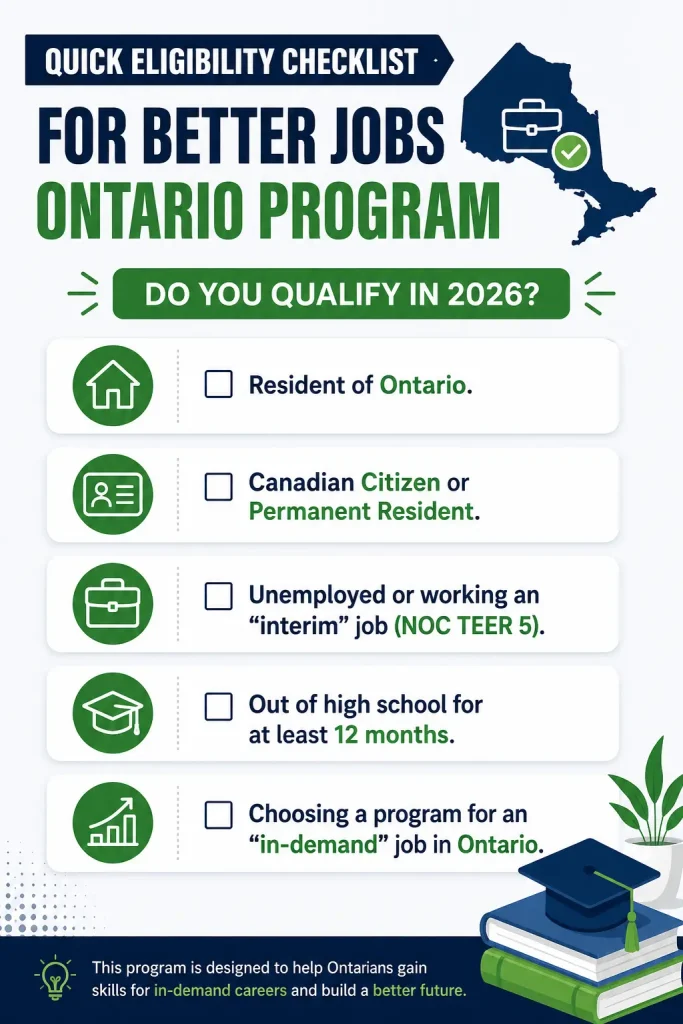
To be eligible for the Better Jobs Ontario Program, you must live in Ontario and be a Canadian citizen or permanent resident.
You generally fall into one of two categories:
- The Laid-Off Worker:
- You were laid off and are currently unemployed
- You were laid off and are currently working a temporary job just to pay bills.
- The Low-Income Job Seeker: You haven’t been laid off, but you’ve been unemployed for at least 12 weeks (or 6 months in some cases) and belong to a low-income household.
You can still apply if you receive any of the following forms of income assistance:
- Employment Insurance (EI)
- Ontario Works (OW)
- Ontario Disability Support Program (ODSP)
How to Prepare for Better Jobs Application?
Where preparing for Better Jobs Ontario application, you may have to provide information about:
- How long you have been unemployed, or working your temporary job, and looking for work
- Level of education obtained
- Previous employment details, how long you worked there and skills that were required
- What skills you want to obtain and where you can get trained in them
The amount of support you may receive is based on individual needs and available funding.
When you apply to Better Jobs Ontario, you must provide information to support a financial needs assessment, such as:
- Some of the costs to be covered during training (meaning tuition and books)
- Your gross (before tax) household income
Better Jobs Ontario Program List & Courses
Not every course is covered on Better Jobs Ontario program. To get approved, your training must lead to a career in NOC TEER 2, 3, or 4 categories. These are jobs with “good” or “very good” prospects in the Ontario labor market.
Popular and In-demand Better Jobs Ontario Courses in 2026:
- Healthcare: Personal Support Worker (PSW), Medical Administration.
- Business, Finance & Administration: Accounting Technician, Accounting and Payroll, Office Administrative Assistant, Supply Chain and Logistics, System Administrator.
- Community & Education: Early Childhood Education, Community Services Worker.
- Skilled Trades: HVAC Technician, Electrician, Heavy Equipment Operator.
- Technology: Web Development, Cybersecurity, Data Analytics.
- Logistics: Transport Truck Driving (AZ/DZ License).
Note: The training must typically be 52 weeks or less, though some programs up to 2 years (104 weeks) are now eligible under specific Better Jobs Ontario Guidelines.
How to Use the Better Jobs Ontario Fast Track Program
If you were laid off from a sector that has seen massive job losses recently, you may qualify for the Better Jobs Ontario Fast Track Program.
Why use Fast Track?
- Less Paperwork: You don’t have to research as many schools.
- Quicker Approval: The ministry prioritizes these applications to get you back to work faster.
- Streamlined Research: You may only need to provide info on one school instead of three.
Step-by-Step: Better Jobs Ontario Application Process
Applying for the Better Jobs Ontario Program may feel confusing at first, but the process becomes much easier when you break it into simple steps.
Step 1: Check Your Basic Eligibility
Before applying for Better Jobs, confirm that you meet the main requirements provided above.
Step 2: Research In-Demand Careers
You usually need to research at least three different schools. At least one must be a College of Applied Arts and Technology (public college) and one must be a Private Career College.
Better Jobs Ontario mainly supports training linked to occupations that have strong hiring demand in Ontario.
Step 3: Choose an Approved Training Program
Next, find a recognized college or training institution in Ontario.
You must select a program that:
- is realistic,
- has strong job prospects,
- and fits your background and goals.
Step 4: Contact an Employment Ontario Office
You cannot apply alone. You must visit an Employment Ontario service provider. They will help you complete a Common Assessment (CA) and an Employment Action Plan (EAP).
They will:
- review your situation,
- explain funding rules,
- help build your application,
- and assess your eligibility.
Step 5: Complete the Better Jobs Ontario Form or Application
You will need to submit:
- Better Jobs Ontario Application for Financial Assistance.
- A formal Letter of Acceptance from your school.
- The Better Jobs Ontario Request for Authorization to Quit Employment (ATQ) form if you are leaving a temporary job to start training.
You may need to provide:
- Personal Documents: Government ID, SIN number, Ontario address proof, Resume
- Employment Documents: Record of Employment (ROE), Layoff letter (if applicable), Recent pay stubs, Employment history
- Financial Information: Bank statements, Household income details, EI information (if receiving benefits)
- Education Documents: High school records, Previous certifications, College transcripts (if available)
Step 6: Ministry Review
After submission by counselor, your application goes through review. The Ministry of Labour, Immigration, Training and Skills Development (MLITSD) usually takes about 3 to 5 weeks to give a final answer.
Processing times can vary depending on:
- application volume,
- region,
- funding availability,
- and document completeness.
Possible Outcomes:
| Result | Meaning |
|---|---|
| Approved | Funding is granted |
| Conditional Approval | More information needed |
| Denied | Application not accepted |
Step 7: Receive Funding Approval
If you are approved for Better Jobs Ontario Program, funding may cover:
| Expense | Possible Coverage |
|---|---|
| Tuition | ✔ |
| Books | ✔ |
| Transportation | ✔ |
| Childcare | ✔ |
| Living Expenses | ✔ |
| Disability Support | ✔ |
Funding amounts vary by situation and training program.
Some applicants may receive support worth up to $28,000–$35,000 total.
Step 8: Start Your Training Program
Once funding is finalized, you can officially begin training. This is the exciting part.
You are now preparing for a completely new career path with government support helping reduce financial pressure.
Many graduates later move into:
- full-time employment,
- higher salaries,
- better job stability,
- and long-term career growth.
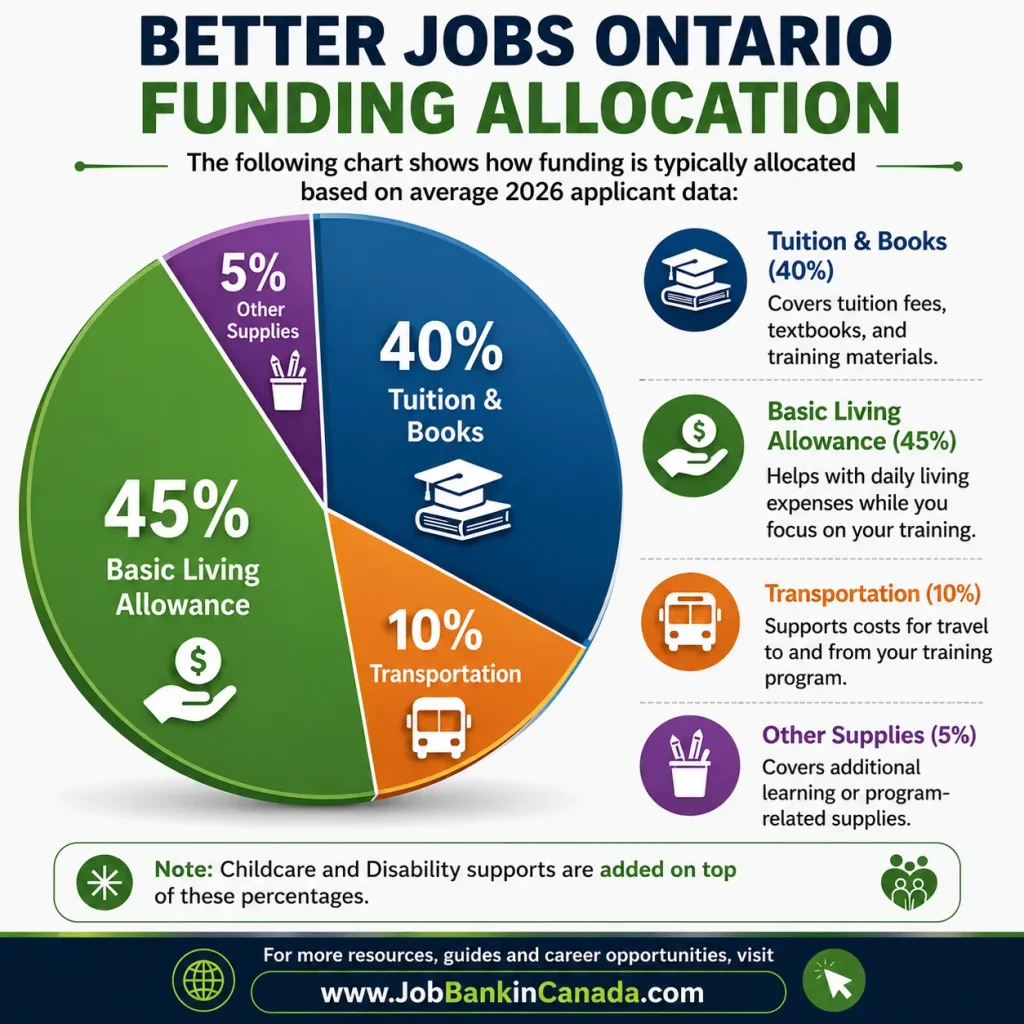
Better Jobs Ontario: Comparison of Support Levels
The following chart shows how funding is typically allocated based on average 2026 applicant data:
Frequently Asked Questions
1. Do I have to pay back the money I receive from Better Jobs Ontario?
No, this is a non-repayable grant, not a loan. You only need to pay it back if you leave your program early without a valid reason.
2. Can I apply if I am already receiving EI, OW, or ODSP?
Yes, you can still apply while receiving these benefits. Your grant will be coordinated with your current support to cover your training and living costs.
3. What is the maximum duration for a training program?
Most funded programs must be 52 weeks or less, though some vocational courses can last up to two years. Longer programs may require applying for OSAP instead.
4. How much household income can I have to be eligible?
For those not laid off, Better Jobs Ontario eligibility depends on household size and low-income status. Monthly income thresholds typically range from $1,294 for one person to $2,081 for families of four or more.
5. Do I have to research both public and private colleges?
Yes, you must usually research at least three training institutions. This list must include at least one public college and one private career college.
6. What “in-demand” jobs are covered by the program?
The Better Jobs Ontario program covers training for jobs with “good” or “very good” prospects in Ontario. Examples include roles in healthcare, skilled trades, accounting, and IT support.
7. Can I get help with childcare while I study?
Yes, additional funding is available specifically for dependent care costs. This support can increase your total funding beyond the standard $28,000 cap to a maximum of $35,000.
8. How long does the Better Jobs Ontario application process take?
The ministry review typically takes several weeks after your complete package is submitted. To avoid delays, work closely with your Employment Ontario counselor to gather all required forms.
9. Do I have to pay for the application?
Applying for the grant is free. However, colleges may charge an application fee (like the $125 fee for OntarioColleges.ca).
Final Thoughts: Take the First Step Today
Waiting to apply only delays your new career. Because the Ontario Better Jobs program is based on available yearly budgets, it is best to start your Better Jobs Ontario Application as soon as possible.
Action Plan:
- Find your local Employment Ontario office.
- Ask about the Better Jobs Ontario Guidelines for 2026.
- Choose a program from the Better Jobs Ontario Program List.
Your future is worth the investment. Start your journey toward a better career in Ontario today!

